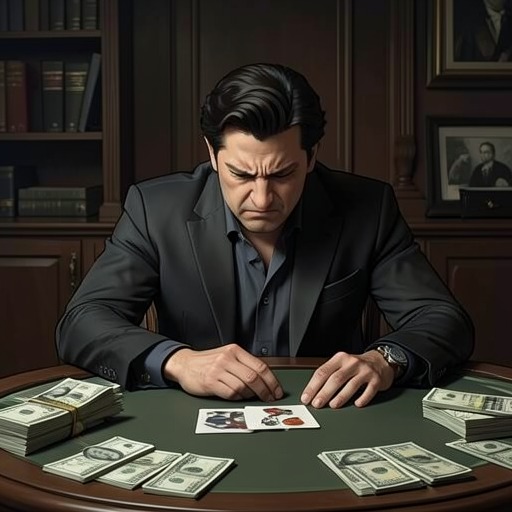
Steve Frazier
Needful ThingsSteve Frazier is a largely offstage figure whose remembered role is decisive: as Castle Rock’s Head Selectman and Danforth Keeton’s political superior, he took the younger official to Lewiston Raceway and helped set in motion the gambling addiction that would consume Keeton’s public and private life. Frazier was already dead by the time Keeton revisited that first trip, but its consequences persisted in the town’s financial records and in Keeton’s increasingly persecutory fear of exposure.
Position in Castle Rock
Frazier had been Castle Rock’s Head Selectman when Keeton was Third Selectman. He had been dead for at least five years by the time Keeton recalled their trip to Lewiston, and was described as having been in his grave for five years or more. The recollection places Frazier within an older municipal hierarchy: Keeton saw him as a political gatekeeper, despite privately judging him an irritating, unimpressive man.
Frazier’s authority mattered more to Keeton than personal affection did. Keeton had ambitions to become Head Selectman and regarded Frazier as essential to that future. When Frazier suggested an evening out during a statewide conference, Keeton had little desire to spend time with him, yet went along because Frazier was the Head Selectman. The decision reveals how political deference and calculation carried Keeton into a private setting he would otherwise have avoided.
The trip to Lewiston
The journey took place during a two-day conference of county officials about the new revenue-sharing laws. Frazier and Keeton went to Lewiston with Butch Nedeau, Castle Rock’s overseer of County Social Services, and Harry Samuels, a long-serving Selectman. Nedeau and Samuels declined Frazier’s invitation to go out for the evening, while Keeton joined him. The conference subject would later take on a grim significance: revenue-sharing provided Keeton with a financial mechanism he exploited, and the resulting records became central to the threat of an audit.
Frazier and Keeton first stopped at The Holly, where Frazier drank Scotch-and-waters and watched the performers. Keeton remembered the evening as one he expected to be long. Frazier then took him to Lewiston Raceway, arriving in time for the fifth pace. At the betting windows, Keeton protested that he knew nothing about betting. Frazier brushed the objection aside and urged him to bet, presenting the night as a lucky one. That casual encouragement was the hinge between an ordinary political excursion and the beginning of Keeton’s gambling trouble.
Influence on Danforth Keeton
Frazier’s part in Keeton’s downfall was not that of a continuing partner or conspirator. He introduced Keeton to the track, but Keeton’s later choices and responsibility were his own. Even so, the remembered first night gives the addiction a specific beginning: Keeton was initially reluctant, went because of his superior’s invitation, and then stayed at the track after Frazier departed. When Frazier said he would leave after the ninth race, Keeton chose to remain. He scarcely noticed Frazier going, and welcomed the absence of the man who habitually called him Buster, a nickname Keeton hated.
The following week Keeton returned alone. He lost sixty dollars from his previous winnings and barely cared. The pattern that followed would recur throughout his life: a loss did not end the visit or restore control; it helped draw him back. Frazier had opened the door, but Keeton continued through it without him. In Keeton’s memory, Lewiston Raceway became a trap whose pull he recognized but could not reliably resist.
Political success and financial ruin
For three years after that first experience, Keeton stayed away from the track. In 1984, Frazier retired, and Keeton was elected Head Selectman. Keeton celebrated his own victory by returning to Lewiston Raceway and betting more heavily than before. He lost $160 that night, more than he felt comfortable losing, and understated the amount to his wife, Myrtle Keeton. A week later he returned hoping to recover the loss; instead, he lost another $210. The next shortfall threatened to show in the checking account, so he took $100 from the town’s petty-cash fund to cover it.
That progression distinguishes Frazier’s initiating influence from Keeton’s later conduct. The raceway introduced the compulsion, but Keeton’s rise to the office he had once hoped to attain coincided with an escalation that turned gambling losses into public theft. As a certified public accountant, he tried to keep the financial package intact. By autumn 1990, however, he had found a bookie, allowing him to place bets larger than the track would accept, without improving his luck. The concealed shortfalls and the illicit use of town money made his political standing increasingly vulnerable.
The town’s correspondence eventually threatened to expose what Keeton had hidden. He kept letters from the Bureau of Taxation and his replies in a locked bottom drawer, and the letters bore the notation DK/sl, although his secretary, Shirley Laurence, had typed none of his responses. A demand addressed formally to the Selectmen of Castle Rock called for an audit of all the town books: tax records, state and federal revenue-sharing records, expenses, road maintenance, law-enforcement budgets, Parks Department budgets, and records for the state-funded experimental tree farm. When Keeton found the word EMBEZZLEMENT on one of the posted warnings, the old gambling history and the current threat of official scrutiny converged. Frazier was long gone, but the first trip with him remained the point of origin in Keeton’s account of the ruin that followed.